What Is Srs Surgery Explained Through Medical Science And Patient Journeys

Sex reassignment surgery or gender confirmation surgery remains one of the most transformative yet misunderstood medical interventions of the modern era. Often shrouded in stigma or misinformation, SRS represents a critical step for transgender and gender-diverse individuals seeking alignment between their physical bodies and deeply held identities. Beyond technical procedures, it reflects decades of medical innovation, legal battles, and evolving societal acceptance that have reshaped healthcare landscapes globally. From the earliest recorded cases in the 20th century to today’s cutting-edge reconstructive techniques, SRS has transcended its origins as a niche specialty to become a cornerstone of gender-affirming care.
The journey toward SRS is as complex as the surgeries themselves, demanding rigorous medical evaluation, psychological preparation, and often years of advocacy to access care. While statistics reveal a steady rise in global adoption—with procedures like vaginoplasty and phalloplasty gaining prominence—each case carries unique challenges, from navigating insurance barriers to overcoming cultural resistance. This exploration delves into the science, ethics, and human stories behind SRS, offering clarity on what the surgery entails, who it serves, and why it matters in the broader fight for transgender rights. The discussion also examines how advancements in surgical techniques, from minimally invasive mastectomies to revolutionary genital reconstruction, are redefining possibilities for patients worldwide.
Understanding SRS Surgery: Core Concepts and Definitions
Sex reassignment surgery (SRS), now more commonly referred to as gender-affirming surgery (GAS) or gender confirmation surgery (GCS), represents a critical medical intervention for transgender and gender-diverse individuals seeking physical alignment with their gender identity. This surgical discipline falls under the broader umbrella of transgender healthcare, integrating medical, psychological, and social support to address gender dysphoria—the distress arising from the mismatch between one’s assigned sex and gender identity. Unlike cosmetic or reconstructive surgeries, which focus on aesthetic or functional improvements, SRS prioritizes body modification to reflect a person’s true gender, encompassing procedures that alter primary and secondary sexual characteristics. The evolution of SRS reflects broader societal progress in LGBTQ+ rights, medical ethics, and scientific advancements, transitioning from experimental practices to evidence-based, patient-centered care.
The term "SRS" originated in medical literature to describe surgeries aimed at reassignment, though modern terminology emphasizes gender affirmation to avoid pathologizing transgender identities. This shift underscores the human rights framework of SRS, where surgery is not merely a medical procedure but a necessary component of gender-affirming care. Historically, SRS was confined to niche medical practices, often stigmatized or denied due to societal prejudices. However, advancements in endocrinology, surgical techniques, and psychological evaluations have transformed SRS into a standardized, life-affirming treatment recognized by global health organizations, including the World Professional Association for Transgender Health (WPATH) and the American Medical Association (AMA).
Historical Evolution of SRS: Milestones and Cultural Shifts
The trajectory of SRS is marked by medical innovation, legal battles, and cultural revolutions, each phase reflecting the era’s attitudes toward gender diversity. Early documented cases of sex reassignment date back to the early 20th century, when Magnus Hirschfeld, a German physician and LGBTQ+ advocate, performed one of the first recorded orchiectomies (removal of testes) on a transgender man in 1917. However, it was not until the 1950s and 1960s that SRS gained limited medical traction, primarily in Europe and North America, driven by pioneers like Dr. George J. Burou (Brazil), who developed early techniques for vaginoplasty, and Dr. Christian Jorgensen, whose 1952 reassignment surgery for Christine Jorgensen became a global sensation, sparking public discourse.
The 1970s and 1980s saw the establishment of specialized transgender clinics, such as the Stanford Gender Center (1966) and the Boston Center for Transgender Health (1980s), which standardized psychological evaluations and surgical protocols. Legal recognition of gender transitions also emerged during this period, with Denmark becoming the first country to legally recognize sex reassignment in 1989, setting a precedent for other nations. The 1990s marked a turning point with the Harry Benjamin International Gender Dysphoria Association (HBIGDA), now WPATH, publishing the Standards of Care (SOC), which provided ethical guidelines for SRS, including mandatory mental health evaluations and real-life experience (RLE) requirements to ensure patients were prepared for surgery.
Table of Contents
- Understanding SRS Surgery: Core Concepts and Definitions
- Historical Evolution of SRS: Milestones and Cultural Shifts
- Global Adoption of SRS: Demographics and Procedure Trends
- Comparison of Common SRS Procedures: Purpose, Recovery, and Risks
- Types of SRS Procedures: Surgical Techniques and Specializations
- Anatomical and Physiological Transformations in SRS
- Vaginoplasty: Surgical Steps, Materials, and Postoperative Outcomes
- Phalloplasty: Techniques, Materials, and Functional Considerations
The 21st century has witnessed accelerated progress in SRS accessibility and techniques: - 2002: WPATH updated its SOC to emphasize informed consent models, reducing barriers for minors in some regions (e.g., Netherlands allowing SRS for minors under specific conditions). - 2011: The American Psychological Association (APA) released a resolution endorsing gender-affirming care, including SRS, as essential for transgender individuals. - 2015: The Affordable Care Act (ACA) in the U.S. began requiring insurance coverage for SRS, though implementation remains inconsistent due to political and legal challenges. - 2020s: Telemedicine and remote evaluations expanded access during the COVID-19 pandemic, while anti-trans legislation in some U.S. states created new hurdles, highlighting the global divide in healthcare policies.
Global Adoption of SRS: Demographics and Procedure Trends
The adoption of SRS has grown exponentially over the past two decades, driven by increased visibility of transgender identities, medical advancements, and advocacy efforts. According to the 2021 U.S. Transgender Survey (USTS), 12% of respondents reported undergoing SRS, with higher rates among binary transgender individuals (18%) compared to non-binary individuals (7%). Globally, Europe and North America lead in SRS adoption, though disparities persist due to legal restrictions, cost, and cultural stigma. For instance: - Sweden and Belgium have among the highest rates of SRS, with ~1 in 5 transgender individuals accessing surgery, thanks to national healthcare coverage. - Latin America, particularly Argentina and Brazil, has seen a surge in SRS since the 2012 Gender Identity Law, which guarantees free surgery and legal gender recognition. - Southeast Asia (e.g., Thailand, Singapore) is emerging as a hub for medical tourism, attracting patients from conservative regions where SRS is restricted.
Procedure preferences vary by gender identity and region: - Feminizing surgeries (e.g., vaginoplasty, breast augmentation) are the most common among transgender women, accounting for ~60% of procedures in Western countries. - Masculinizing surgeries (e.g., phalloplasty, metoidioplasty, hysterectomy) are increasingly sought by transgender men, with phalloplasty (constructing a neophallus) growing in popularity despite its longer recovery (12–24 months) and higher complication rates. - Top surgeries (e.g., mastectomy, chest masculinization) are the most frequently performed, with ~80% of transgender men opting for mastectomy and ~40% of transgender women undergoing breast augmentation.
Age demographics show that ~60% of SRS patients are between 18–35 years old, though adolescent SRS is increasingly debated, with Tanner stage-based criteria (e.g., Netherlands allowing SRS for minors at Tanner Stage 4–5) being adopted in some regions. Non-binary and genderqueer individuals represent a smaller but growing segment, often opting for partial procedures (e.g., hysterectomy without vaginoplasty or mastectomy without phalloplasty).
Comparison of Common SRS Procedures: Purpose, Recovery, and Risks
SRS encompasses a diverse range of procedures, each tailored to an individual’s gender goals, anatomy, and medical history. Below is a comparative analysis of the most prevalent surgeries, highlighting their primary purposes, recovery timelines, and associated risks.
- Purpose and Procedure Overview SRS procedures are categorized based on their anatomical focus and gender-affirming goals:
- Feminizing Procedures: Aim to create female secondary sexual characteristics, often involving hormone therapy (HT) as a precursor.
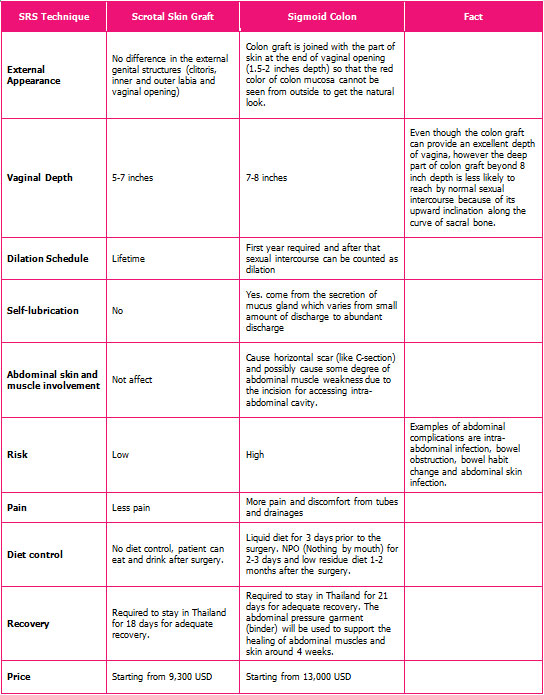
- Vaginoplasty: Constructs a vagina using penile and scrotal tissue (inversion vaginoplasty) or intestinal tissue (sigmoid colon vaginoplasty). May include labia construction and clitoris formation.
- Breast Augmentation: Uses implants or fat transfer to create breast tissue, often combined with areola tattooing for natural appearance.
- Masculinizing Procedures: Focus on developing male secondary sexual characteristics, frequently requiring hysterectomy/oophorectomy for transgender men.
- Mastectomy (Chest Reconstruction): Removes breast tissue via subcutaneous mastectomy or keyhole mastectomy, with options for chest contouring.
- Phalloplasty: Constructs a neophallus using radial forearm free flap (RFFF), anterolateral thigh (ALT) flap, or fibula free flap, followed by urethral lengthening and scrotoplasty.
- Metoidioplasty: Uses the clitoris and urethra to create a small phallus, often combined with hysterectomy and scrotoplasty. Requires erectile dysfunction management (e.g., penile implants).
- Orchiectomy: Removal of testes to stop estrogen production and reduce cancer risk, often performed early in transition.
- Hysterectomy: Removal of the uterus and cervix, sometimes paired with oophorectomy (ovary removal) to eliminate menstrual cycles.
-
Recovery Tim
Types of SRS Procedures: Surgical Techniques and Specializations
Sex Reassignment Surgery (SRS) encompasses a diverse array of procedures designed to align a person’s physical anatomy with their gender identity. Each technique targets specific anatomical and physiological transformations, requiring specialized surgical expertise, precise preoperative planning, and tailored postoperative care. The procedures vary in complexity, recovery timelines, and outcomes, with advancements in medical technology enabling increasingly refined and personalized approaches. Below is a detailed exploration of the primary SRS techniques, their anatomical impacts, surgical methodologies, and the specialized skills required to perform them effectively.Anatomical and Physiological Transformations in SRS
SRS procedures induce profound changes in both external and internal anatomy, often involving the removal, reconstruction, or augmentation of tissues to achieve gender-affirming results. These transformations are not merely cosmetic but also address functional aspects, such as hormonal balance, urinary continence, and sexual function. Understanding the physiological changes requires visualizing the pre- and postoperative states through labeled anatomical diagrams, which surgeons and patients use to align expectations. Breast Tissue Removal and Reconstruction (Top Surgery) For male-to-female (MTF) patients, the primary goal is the removal of breast tissue (mastectomy) and, in some cases, the creation of breast contours through tissue expansion or implants. The process involves: - Breast tissue excision to eliminate glandular and fatty tissue, reducing chest masculinization.
- Skin resizing to achieve a feminine contour, often through techniques like periareolar or keyhole incisions.
- Fat grafting or implant placement to create breast volume and shape, mimicking natural female anatomy. Visualization: A labeled diagram would show the chest pre-surgery with prominent pectoral muscles and glandular tissue, transitioning to a postoperative state with smooth contours, nipple-areola complexes repositioned, and optional breast augmentation. For female-to-male (FTM) patients, top surgery focuses on:
- Breast tissue removal (mastectomy) to eliminate glandular tissue and fat.
- Pectoral muscle definition enhancement, often through liposuction or muscle reshaping.
- Nipple-areola complex repositioning to a higher, more masculine placement. Visualization: A diagram would illustrate the removal of breast tissue, the reshaping of the pectoral region, and the repositioning of nipples to a flatter, more central chest line. Genital Reconstruction Genital SRS procedures, such as vaginoplasty and phalloplasty, involve the creation or modification of genital structures to align with gender identity. These surgeries are highly specialized and require expertise in reconstructive techniques, flap surgery, and microsurgical anastomosis (connecting blood vessels). Visualization: For vaginoplasty, a diagram would depict the inversion of penile tissue to form a vaginal canal, with the creation of a neoclitoris from remaining tissue or grafts. For phalloplasty, the diagram would show the construction of a penis using skin flaps (e.g., radial forearm or anterolateral thigh flaps), urethral reconstruction, and scrotal creation.
- Penile skin: The primary tissue source for the vaginal lining, offering natural sensation and elasticity.
- Skin grafts (if needed): For cases where penile skin is insufficient, grafts from other body areas (e.g., thigh or forearm) may be used.
- Synthetic or biologic meshes: Occasionally employed to reinforce vaginal walls and prevent stenosis (narrowing).
- Fat grafting: Used to enhance labial volume or correct contour irregularities. Postoperative Outcomes:
- Vaginal depth and width: Typically ranges from 6–8 cm in depth, with adjustments possible during dilation therapy.
- Sensation: Natural sensation in the neovagina and neoclitoris, though variability exists based on tissue preservation.
- Sexual function: Most patients achieve penetrative intercourse, though some may experience reduced sensation or dryness, managed with lubricants or hormonal therapy.
- Recovery: Initial healing takes 4–6 weeks, with full dilation therapy (using graduated dilators) required over 3–6 months to maintain vaginal openness. Complications:
- Vaginal stenosis: Narrowing of the vaginal canal, often due to insufficient dilation.
- Urethral stricture: Narrowing of the urethral opening, potentially requiring dilation or surgery.
- Scarring or contractures: Excessive scarring can affect sensation or function, sometimes necessitating revision surgery.
- Donor site morbidity: If skin grafts are used, scarring or sensation loss at the graft harvest site may occur.
- Flap source: Skin, fat, and blood vessels from the forearm.
- Urethra: Constructed using buccal (mouth) mucosa or skin grafts, extended to the tip of the neophallus.
- Advantages: Longer length potential, good sensation, and reliable blood supply.
- Disadvantages: Donor site scarring on the forearm, limited width. 2. Anterolateral Thigh (ALT) Phalloplasty:
- Flap source: Skin and tissue from the thigh, preserving sensation.
- Urethra: Typically requires buccal mucosa grafts for full-length urethras.
- Advantages: Less donor site morbidity (hidden in underwear), wider flap for better girth.
- Disadvantages: Shorter length compared to RFF, potential for bulkiness. 3. Scapular/Parascapular Phalloplasty:
- Flap source: Skin and tissue from the upper back.
- Urethra: Often requires staged reconstruction.
- Advantages: Hidden donor site, potential for longer length with experienced surgeons.
- Disadvantages: Complex surgery, longer recovery, and limited sensation. Surgical Steps: 1. Flap harvest: The chosen skin flap (e.g., forearm or thigh) is removed with its blood vessels intact. 2. Vascular anastomosis: The flap’s blood vessels are connected to recipient vessels in the pubic region (e.g., femoral vessels). 3. Urethral construction: Buccal mucosa or skin grafts are tubularized to create a urethra, often requiring staged procedures. 4. Phallus shaping: The flap is sculpted into a penile form, with or without a prosthesis pocket for future implant placement. 5. Scrotum creation: Testicular implants or fat grafting may be used to complete the appearance. Materials Used:
- Skin flaps: Radial forearm, anterolateral thigh, or scapular tissue.
- Buccal mucosa: Harvested from the inner cheek for urethral lining due to its elasticity and resistance to stricture.
- Prosthetic implants: Inflatable or malleable penile implants may be inserted in later stages (6–12 months post-phalloplasty).
- Testicular implants: Silicone or saline-filled prosthetics placed in the labia majora to mimic scrotum. Postoperative Outcomes:
- Erection function: Phalloplasty alone does not provide natural erections; implants or pumps are required for rigidity.
- Sensation: Variable, with RFF offering the best tactile feedback due to preserved nerves.
- Urethral complications: Strictures or fistulas (abnormal connections) are common, often requiring multiple revisions.
- Recovery: Initial healing takes 2–3 weeks, with full flap integration over 6–12 months. Urethral reconstruction may require additional surgeries. Complications:
- Flap necrosis: Partial or full tissue death due to poor blood supply, necessitating revision.
- Urethral stricture: Narrowing requiring dilation or surgical correction.
- Prosthesis-related issues: Infection, erosion, or mechanical failure in
Vaginoplasty: Surgical Steps, Materials, and Postoperative Outcomes
Vaginoplasty is the surgical creation of a vagina and often includes the formation of a neoclitoris and labia. The procedure is typically performed on MTF individuals and involves the following steps: Surgical Steps: 1. Orchiectomy (if not previously performed): Removal of the testes to eliminate endogenous testosterone production, often done concurrently or prior to vaginoplasty. 2. Penile inversion: The penile skin and erectile tissue are inverted to form the vaginal canal. The urethra is rerouted to open at the base of the neovagina. 3. Neoclitoris construction: A small portion of the glans or adjacent tissue is preserved or grafted to create a sensitive clitoris. 4. Labia creation: Excess penile or scrotal skin is used to form labia majora and minora. 5. Perineal reconstruction: The area between the vagina and anus is reshaped for a natural appearance. Materials Used:Phalloplasty: Techniques, Materials, and Functional Considerations
Phalloplasty is the surgical construction of a penis and is performed on FTM individuals or transmasculine patients. The procedure involves multiple stages and requires microsurgical expertise due to the complexity of urethral reconstruction and flap anastomosis. Types of Phalloplasty: 1. Radial Forearm Phalloplasty (RFF):Sex reassignment surgery is more than a medical procedure—it is a pivotal moment in the lives of countless individuals, marking the convergence of personal identity and physical reality. As societal attitudes continue to shift and medical science refines its approaches, SRS stands at the forefront of progressive healthcare, offering not just physical transformation but also the potential for profound emotional liberation. From the operating room to the courtroom, the story of SRS reflects broader struggles for dignity, access, and recognition. For those considering this path, understanding the nuances—whether through statistical trends, surgeon specializations, or firsthand patient experiences—can illuminate both the challenges and the life-changing rewards that lie ahead.
Leave a Comment
Comments are moderated before appearing. The data you submit is processed according to the Privacy Policy of Inhonorofdesign.